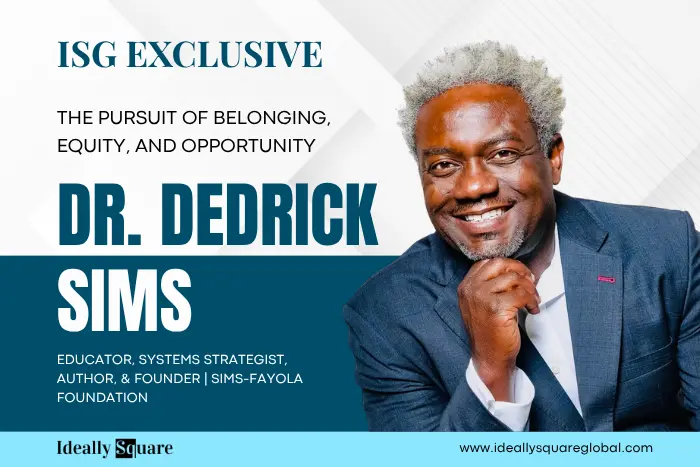
Dr. Dedrick Sims: The Pursuit of Belonging, Equity, and Opportunity
Every community tells a story about what it values. It is a lesson Dr. Dedrick Sims began learning long before he became an educator, Army officer, school leader, nonprofit executive, Harvard Fellow, and founder of the Sims-Fayola Foundation. Growing up in Pine Bluff, Arkansas, he observed how opportunity seemed to find some people more easily than others, how certain voices were heard more readily, and how some individuals moved through systems designed to support their success while others struggled to be seen.
Every community tells a story about what it values. It is a lesson Dr. Dedrick Sims began learning long before he became an educator, Army officer, school leader, nonprofit executive, Harvard Fellow, and founder of the Sims-Fayola Foundation. Growing up in Pine Bluff, Arkansas, he observed how opportunity seemed to find some people more easily than others, how certain voices were heard more readily, and how some individuals moved through systems designed to support their success while others struggled to be seen. Decades later, those early observations would evolve into a lifelong commitment to understanding how environments shape human potential and how systems can be redesigned to create more equitable outcomes.
For Dr. Dedrick Sims, understanding those signals has become a life's work. As an educator, systems strategist, author, and founder of the Sims-Fayola Foundation, he has spent years examining the relationship between human potential and the systems designed to support it. Through the Sims-Fayola Foundation, Dr. Dedrick and his team have supported thousands of young people, families, educators, and community leaders while helping organizations rethink how systems shape opportunity and belonging.
Understanding the Systems Behind the Outcomes
Long before Dr. Dedrick Sims became an educator, principal, school founder, nonprofit executive, Harvard Fellow, or creator of the Sims Framework, he was observing patterns that would later shape his life's work. Growing up in Pine Bluff, Arkansas, he noticed that success was not always determined by talent or effort alone. The environments people inhabited, the expectations placed upon them, and the opportunities available to them often shaped outcomes just as much as individual ability.
Those early observations stayed with him as he entered military service. As an Army officer, Dr. Dedrick gained firsthand experience with leadership, accountability, culture, and organizational systems. He saw how structure influences performance and how the same individuals can thrive or struggle depending on the environments in which they operate. The military strengthened his appreciation for the power of systems and reinforced a lesson that would later become central to his life's work: people do not operate in isolation. Their experiences are shaped by the conditions surrounding them.
When Dr. Dedrick transitioned into education, he carried those lessons with him. As a teacher, curriculum leader, principal, school founder, district administrator, and nonprofit executive, he found himself repeatedly confronting the same reality. Across schools, communities, and organizations, he encountered talented young people whose potential often exceeded the opportunities available to them. The pattern appeared too consistently to ignore.
Over time, one group remained at the center of his observations. Again and again, he saw boys and young men of color navigating systems that frequently underestimated their strengths, misunderstood their experiences, or focused more heavily on their challenges than their possibilities. Whether discussing academic achievement, discipline, leadership opportunities, belonging, or long-term success, he observed a persistent gap between the potential he saw in young men and the opportunities many systems created for them.
That realization became a defining force in his leadership journey. The question was no longer how to help individual young people succeed despite the barriers around them. The question became how those barriers were being created in the first place. Understanding that distinction would ultimately shape the direction of his career and lay the foundation for the work that followed.
The journey from Pine Bluff to Army officer, educator, principal, school founder, nonprofit executive, Harvard Fellow, and creator of the Sims Framework has been guided by a single question: how can systems be designed to help people realize their full potential rather than limit it?
The Birth of the Sims Framework
The Sims Framework didn’t spring from one flash of inspiration. Rather, it evolved from years of observation, reflection, and leadership throughout a range of sectors.
At the center of the Sims Framework is a simple but powerful observation: outcomes emerge from the interaction of belief, structure, and practice. What adults believe influences the systems they create. Those systems shape daily experiences. And those experiences ultimately shape outcomes. The framework helps leaders examine that relationship and understand how belonging, opportunity, and achievement are produced.
Throughout his career, Dr. Dedrick has seen a common theme in organizations: they treat outcomes as problems of individuals. Academic struggles were only seen as academic problems. Behavioral problems were addressed as behavioral issues. Engagement issues were considered in isolation from the broader context in which they were embedded.
But he regularly found these results to be very much tied to the systems in which people operated. Schools, organizations, and communities constantly sent messages that said who belonged, who mattered, what was expected, and what was possible.
The Sims Framework was developed as a tool to help leaders discover those deeper dynamics. It encourages leaders to look at the beliefs, systems, routines, and practices that are producing the results they are getting, rather than just focusing on the results they want. For Dr. Dedrick, real change doesn’t come from telling people they’re wrong, but from understanding and redesigning the systems that shape their lived experiences.
Recognizing the Talent Hidden in Plain Sight
For Dr. Dedrick, the decision to focus much of his work on boys and young men of color did not emerge from a single moment. It developed through thousands of interactions across classrooms, schools, communities, and leadership spaces. While data often revealed troubling patterns, it was the conversations behind those numbers that left the deepest impression.
Again and again, he met young men searching for affirmation, belonging, purpose, and opportunity. Many were navigating environments that were quick to identify their shortcomings but slower to recognize their strengths. Those experiences reinforced his belief that the issue was rarely a lack of potential. More often, it was a lack of systems intentionally designed to nurture that potential.
While the Sims-Fayola Foundation has impacted thousands of young men and boys of color, the moments that remain most meaningful to Dr. Dedrick are often the quietest ones.
Rather than focusing on awards, recognition, or public achievements, he points to the countless conversations he has shared with young people seeking clarity about identity, purpose, belonging, relationships, and their future. These interactions revealed a recurring need: many young men were not seeking lectures or directives. They were seeking space to reflect, process, and be heard.
One conversation in particular left a lasting impression. A young man shared that most adults only engaged with him when he had made a mistake. Few had ever asked him about his dreams, aspirations, or what he believed he could accomplish.
Experiences like these ultimately inspired Hey Man, We Jus Talkin', an initiative rooted in creating authentic spaces for dialogue and self-discovery. Throughout his work, Dr. Dedrick has witnessed young men once labeled by others become leaders, entrepreneurs, advocates, mentors, and graduates. These transformations reinforced a belief that has guided much of his work: potential is rarely the problem. More often, the challenge lies in whether environments are designed to recognize, cultivate, and support that potential.
When Belonging Becomes Intentional
Dr. Dedrick believes belonging gets misunderstood a lot. He says it's not just about how individuals feel. Instead, it's about the treatment they get from the systems around them over time.
According to Dr. Dedrick, feelings of belonging come from lots of small experiences piling up. People watch who gets chances, who's listened to, and how folks recover from mistakes. Do some people always get a break, while others constantly face punishment? This shapes everyone's sense of value and inclusion.
When dealing with schools and groups, Dr. Dedrick tells leaders to look beyond emotions. Instead of asking if folks think they fit in, he advises investigating the experiences the system creates. Inquiries into equity and respect can actually tell you more than any official mission statement ever will.
This perspective is particularly important for boys and young men of color, many of whom spend years in environments that unintentionally position them as exceptions rather than assets. For Dr. Dedrick, belonging should never be left to chance. It should be intentionally designed into every aspect of a system.
Lessons in Leadership and Alignment
As a fellow at the Harvard Kennedy School, Dr. Dedrick was able to step back from the day-to-day pressures of leadership and spend time wrestling with larger questions of systems change, public leadership, and institutional design.
After years of building schools, organizations, partnerships, and initiatives, the fellowship gave space to think about bigger questions of leadership, systems change, and public institutions. One of the biggest lessons he’s learned is that many of the leadership challenges can’t be solved by expertise alone. Rather, they challenge individuals and organizations to question assumptions, rethink current beliefs, and align their actions around a common purpose.
The experience also reinforced a pattern he had seen throughout his career: organizations rarely get in trouble because they lack vision. More often, they struggle because their structures, incentives, and day-to-day practices are not aligned with that vision.
The fellowship didn’t change Dr. Dedrick’s thinking at a fundamental level. Instead, it offered language, perspective, and clarity to ideas he’d been working on for years. More importantly, it “confirmed for him that uncertainty is not a passing leadership issue, but the very environment within which leadership exists.” The ability of a leader to create trust, clarity and alignment despite that uncertainty determines success.
Looking Beyond the Symptoms
One of the biggest mistakes educational and social systems make is to confuse symptoms with causes, Dr. Dedrick says.
Attendance problems become attendance problems. Behavior problems become behavior problems. Disengagement becomes a problem of engagement. But these results are often signs of deeper experiences and conditions that are left unexamined.
Dr. Dedrick has seen throughout his work that young people respond to far more than rules and expectations. They respond to relationship, belonging, predictability, identity, opportunity, and trust. Frequently, when these basic elements are absent, problems appear in other areas.
He is also worried about the fragmentation of support systems. Young people experience life as an interconnected whole, but schools, workforce programs, mental health services, community organizations, and policymakers often work in silos. Too often, the burden of navigating such disjointed systems falls on those least able to do so.
“For Dr. Dedrick, so many of the problems people get blamed for are really signals that the systems around them are providing.” The question is whether leaders are willing to listen and respond as such.
Wellbeing Begins with Environment
Mental health, identity, and well-being have become central themes in Dr. Dedrick's recent work, particularly through the Sims-Fayola Foundation.
He believes one of the most significant misconceptions surrounding youth mental health is the tendency to treat it as separate from everyday environments. While access to services, interventions, trained professionals, and crisis support remains essential, he argues that the environments young people experience daily play an equally important role.
When young people spend years feeling unseen, disconnected, misunderstood, or undervalued, those experiences inevitably influence their wellbeing. Likewise, environments that fail to recognize strengths, communicate low expectations, or limit opportunities can have lasting effects on identity development and mental health.
For boys and young men of color, factors such as representation, belonging, relationships, purpose, and hope are particularly influential. Dr. Dedrick emphasizes that healing does not occur solely in clinical settings. It also emerges through meaningful relationships, supportive communities, and experiences that foster dignity and connection.
Ultimately, he believes the most important question for schools and organizations is not simply whether support services are available. It is whether the environment itself contributes to wellness or unintentionally contributes to harm. Through this lens, wellbeing becomes not only an individual concern but a reflection of the systems surrounding young people every day.
Connecting Systems to Create Lasting Change
For Dr. Dedrick, the various roles he has held throughout his career are not separate professional identities but interconnected pieces of a larger mission. Whether serving as an educator, nonprofit leader, policy advocate, or systems strategist, his focus has remained consistent: understanding how different systems shape the lives of young people.
His career has provided a unique vantage point across classrooms, schools, district leadership, nonprofit organizations, policymaking spaces, boardrooms, and community initiatives. Through these experiences, Dr. Dedrick came to recognize a fundamental reality: young people's lives do not fit neatly within organizational boundaries. A student facing academic challenges may simultaneously be dealing with housing instability, workforce concerns, transportation barriers, family pressures, or mental health struggles.
This understanding strengthened his commitment to systems thinking. He believes that no single institution can produce the outcomes society seeks on its own. Schools, families, community organizations, policymakers, and civic leaders all contribute to the conditions that influence young people's experiences. His work increasingly focuses on helping organizations recognize their role within a larger ecosystem, emphasizing that sustainable change is rarely the result of isolated efforts. Instead, it emerges through alignment, collaboration, and shared responsibility.
Creating Space for Growth and Discovery
Mentorship has been a defining influence throughout Dr. Dedrick's own journey, shaping his understanding of leadership, opportunity, and personal growth. Looking back, he can identify individuals who challenged him, encouraged him, expanded his perspective, and opened doors that may otherwise have remained closed.
These experiences informed his deep belief in the value of mentorship, particularly for boys and young men of color. However, Dr. Dedrick is careful to distinguish meaningful mentorship from occasional advice or encouragement. For him, true mentorship is a developmental relationship grounded in trust, accountability, consistency, and belief.
Much of the inspiration behind Hey Man, We Jus Talkin' emerged from years of conversations with young men grappling with questions about identity, purpose, relationships, failure, success, and manhood. He observed that many lacked safe spaces to explore these important topics openly.
Dr. Dedrick believes the most effective mentors do not provide all the answers. Instead, they help young people develop the confidence and capacity to discover answers for themselves. At the same time, he emphasizes that mentorship alone cannot compensate for poorly designed systems. While mentors can help individuals navigate barriers and expand their sense of possibility, broader systemic change remains essential. His work has therefore focused on strengthening both relationships and systems, ensuring that opportunity does not depend solely on whether a young person encounters the right mentor at the right moment.
Embedding Equity into Everyday Decisions
Throughout his work, Dr. Dedrick has challenged organizations to move beyond viewing equity as a statement of values and instead treat it as a measurable outcome.
He believes that many conversations about equity remain trapped at the level of intention. While most organizations express support for equitable outcomes, the true test comes when equity begins influencing decisions, practices, and accountability systems.
For Dr. Dedrick, effective equity work requires leaders to examine evidence rather than assumptions. Questions about who receives opportunities, who advances into leadership roles, whose voices are heard, who faces disciplinary action, and who consistently succeeds or struggles provide valuable insight into how a system is functioning.
This perspective directly informed the development of the Sims Framework. By examining the relationship between outcomes and organizational design, leaders can move beyond surface-level discussions and begin identifying the beliefs, structures, and daily practices that shape results.
He views equity not as a matter of blame or guilt but as an opportunity for intentional improvement. When organizations operationalize equity, it influences hiring decisions, budget priorities, leadership development, policy implementation, and accountability measures. It becomes embedded within practice rather than remaining an aspirational goal.
Leadership as an Act of Stewardship
Over the course of his career, Dr. Dedrick's understanding of leadership has evolved significantly. Early on, he believed leadership was largely about having answers. Today, he views it as the ability to create clarity, foster alignment, and help people move toward a shared purpose.
His experiences leading schools, founding organizations, managing growth, and navigating setbacks have reinforced an important lesson: leadership is fundamentally an act of stewardship.
Rather than seeing leaders as owners of institutions, Dr. Dedrick views them as temporary caretakers. Their responsibility is to leave organizations stronger, healthier, and more capable than they found them. This perspective helps him manage the pressures and responsibilities that accompany leadership.
He also emphasizes the importance of humility. Some of the most meaningful lessons in his career have come not from formal leadership settings but from conversations with students, educators, parents, community members, and colleagues. Leadership, in his view, is not about being the smartest person in the room but about creating conditions where others can contribute their strengths toward a common goal.
Ultimately, Dr. Dedrick measures leadership not by authority but by the capacity it builds in others. Sustainable leadership occurs when people become more capable because of the environment a leader creates.
Vision 2030: An Evolution in Leadership Thinking
Vision 2030 emerged from one of the most significant realizations of Dr. Dedrick's career. After years of building schools, mentoring young people, developing leaders, and creating impactful programs, he found himself wrestling with a difficult question. If so many dedicated individuals and organizations were doing meaningful work, why did many of the same challenges continue to persist?
The answer was not that programs were ineffective. In fact, many were producing remarkable outcomes. The deeper realization was that programs alone could never fully address challenges rooted in larger systems. Young people might spend a few hours each week participating in exceptional programs, but they spend the rest of their lives navigating schools, workplaces, policies, institutions, and social environments that shape their opportunities every day.
This realization marked a turning point in Dr. Dedrick's thinking. He began to see that lasting impact required more than creating excellent programs. It required influencing the systems that determine how opportunity is distributed, how belonging is experienced, and how outcomes are produced. Vision 2030 became the result of that evolution. More than a strategic plan, it represents a broader commitment to systems change, institutional transformation, and creating environments where boys and young men of color can thrive at scale.
The Power of Asking Better Questions
When speaking to educators, policymakers, and organizational leaders, Dr. Dedrick consistently emphasizes the importance of curiosity.
He believes many institutions operate under pressure to act quickly, respond immediately, and produce rapid solutions. Yet meaningful change often begins not with answers but with better questions.
Rather than asking what is wrong with a young person, he encourages leaders to ask what happened, what conditions are shaping their experience, and what messages systems may be communicating about their value and potential.
Dr. Dedrick argues that every system sends signals about belonging, opportunity, and worth. These messages are often invisible to those creating them but deeply influential to those experiencing them. Understanding those dynamics requires leaders to engage in honest reflection about the structures they inherit and the outcomes they produce.
His work continually returns to a central principle: outcomes tell stories about systems. The challenge for leaders is whether they are willing to listen closely enough to understand what those stories reveal.
A New Lens for Understanding Human Outcomes
Dr. Dedrick's upcoming book, The Sims Framework: Designing Systems of Belonging for Boys and Young Men of Color in Education and Beyond, seeks to spark a broader global conversation about leadership, systems, and human development.
At its core, the book challenges readers to shift their perspective. Rather than immediately focusing on individuals when confronting achievement gaps, discipline disparities, workforce challenges, mental health concerns, or civic disengagement, Dr. Dedrick invites leaders to examine the systems producing those outcomes.
By exploring the relationships among beliefs, structures, practices, and results, the book encourages readers to recognize patterns that often remain hidden beneath the surface. It highlights how policies shape experiences, how culture influences expectations, and how belonging affects performance.
Although the work focuses heavily on boys and young men of color, Dr. Dedrick believes its lessons extend far beyond any single population. Ultimately, the book is about leadership and the responsibility institutions carry in shaping human experiences. His hope is that readers emerge not simply with a new framework, but with a fundamentally different way of seeing the systems around them.
A Legacy of Belonging
As he reflects on the legacy he hopes to leave, Dr. Dedrick spends less time thinking about recognition and more time considering stewardship and responsibility.
The loss of his father reinforced the understanding that leadership is temporary. Every generation eventually passes responsibility to the next. What matters is not whether something is left behind, but what is left behind.
He hopes his work encourages future leaders to spend less time helping people adapt to flawed systems and more time redesigning systems that enable people to thrive. His vision is one where boys and young men of color encounter schools, workplaces, organizations, and communities where belonging is not something they must fight to earn.
Most importantly, he hopes the central idea behind the Sims Framework endures: that human outcomes are shaped by design. Experiences, opportunities, and results are not accidental. They emerge from the systems people create.
Because systems are designed, Dr. Dedrick believes they can also be redesigned. That conviction continues to fuel his work and his optimism. No matter what systems we inherit, he believes we have both the ability and the responsibility to build better ones for those who come after us.
Read the full issue
Open Magazine →